









The Secret to Building a High-Performing Team.
Use this tool to determine whether your team has the connection and courage required.
A Breakthrough Discovery.
A Research-Backed Principle.
A Framework driven by Behavioral Science.
A System That Transforms Cultures.
What began as a breakthrough discovery in behavioral science has become a universal framework for unlocking high-performance cultures in today’s organizations.
From Bottleneck to Breakthrough: How Blue Cross of Idaho Radically Transformed Its Culture
Discover Blue Cross of Idaho’s Journey from stagnation to competitive agility by building a culture of trust, connection and collaboration, to face the organization’s most difficult challenges.
Mastering Change: How to Lead and Thrive in Uncertain Times
An exclusive Last 8% on-demand webinar that explores why the biggest risk to your organization right now is playing it safe.
The Secret to Building a High-Performing Team.
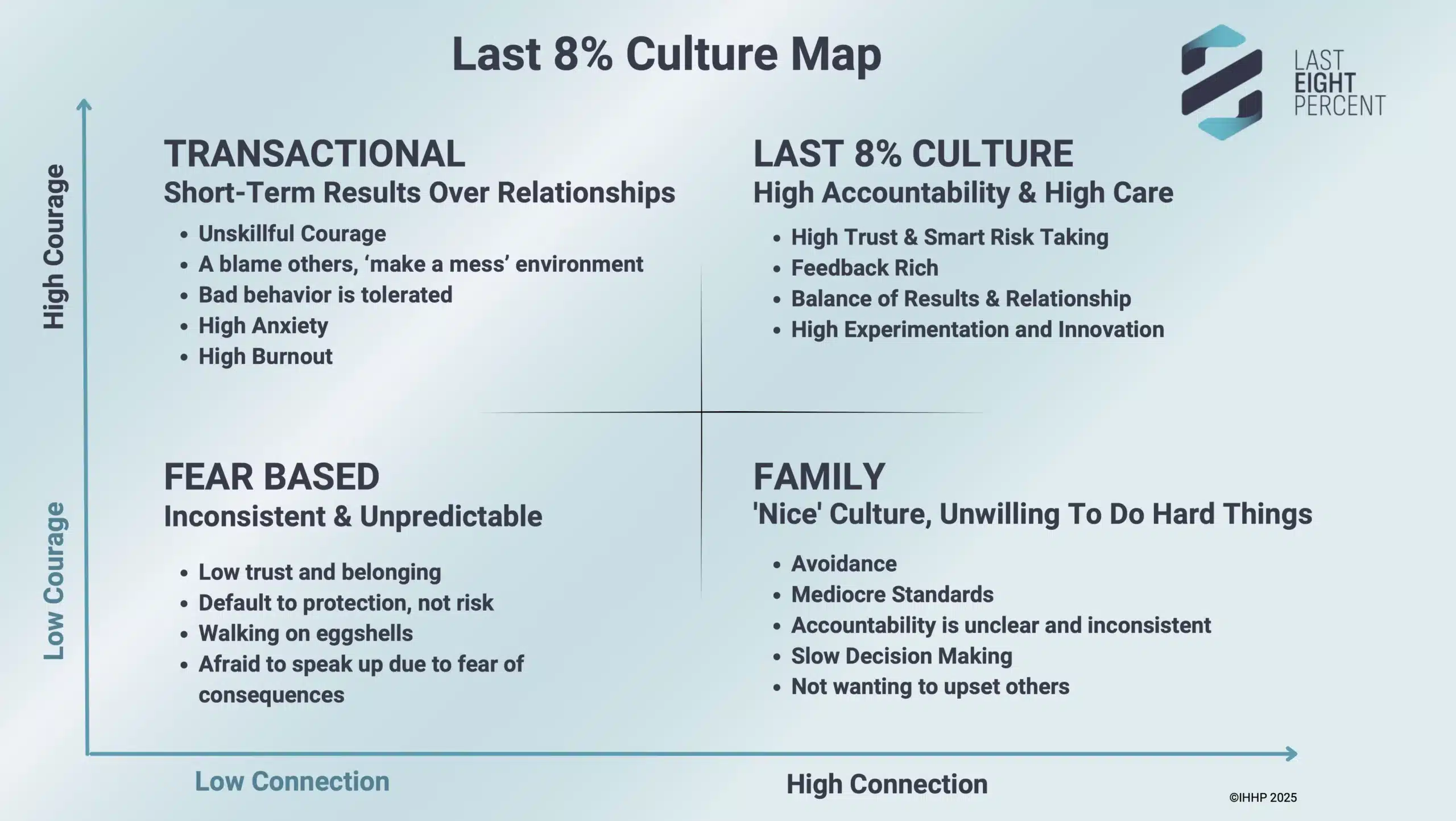
For people to do hard things, your culture needs high connection and high courage.
Born from 25 years of applied research in organizational social psychology and behavioral neuroscience, the Last 8% began as a pivotal insight into human behavior.
Today, it has become a universal framework used by leaders to turn underperforming teams and stagnant cultures into ones defined by courage, connection, and accountability.
The Discovery
In 2001, our team of behavioral scientists began working with leading organizations facing a common problem costing them millions.
Across every industry, we began to hear the same thing from senior leaders:
“We have the right people, but something is missing.”
Teams were talented and well-trained, yet under pressure cracks appeared: collaboration broke down, communication stalled, engagement dropped, and turnover cost millions. Performance suffered — and no one could explain why.
That invisible problem sparked two decades of research, taking us from Olympic locker rooms to NASA training facilities to Fortune 500 boardrooms.
The Approach
We conducted clinical data-driven studies of how high-performing leaders and teams acted under pressure — in hospitals, police departments, classrooms, elite sports, and fortune 500 firms. Each setting provided unique stressors, but all revealed the same hidden blind spot that determined success or failure.
When emotions rise and stakes are high, even the most skilled professionals reach a critical threshold — a moment that decides whether they move forward with courage and clarity, or retreat and fold under pressure.
The Findings
Our research uncovered a hidden pattern: in moments of pressure, we found a measurable gap between the risks people felt they should take… and the ones they actually took.
For instance, people didn’t speak up when they knew they should. They delayed decisions they knew had to be made. They avoided discomfort, even when the cost of doing so was significant. What was the percentage they were avoiding? 7.56%.
They hold back that final stretch, the part that feels most emotionally uncomfortable but is critical for success.
We called it the Last 8%: the defining moment where performance, culture, and connection are either strengthened or lost.
Understanding the “Last 8%” Moment
What you want to say...
Honest, important feedback, truth about how I feel, real concerns…
What you actually say...
Vague comments. sugar coated language, avoidance
It’s not just conversations. It is the part of every tough decision and conversation where something is left unsaid. Something is left undone. The feedback was avoided. The decision delayed. It may seem small in appearance, but it is outsized in impact.
In these moments, teams either align or erode. Leaders either step up or shut down. Cultures either grow stronger or shrink. We began to see that this “missing piece” was consistent across industries and geographies and it was shaping both cultures and the ability of organizations to execute their strategy
The Science Behind the Struggle
Why We Avoid the Hardest Moments
The Last 8% is not simply a matter of willpower. Neuroscience reveals that when social risk is high, the brain’s threat-response system prioritizes self-protection. Even when we feel psychologically safe, we may still avoid the hardest moments—driven by self-doubt or fear of damaging relationships.
What this looks like in your organization:
Leaders hesitate in high-stakes conversations.
Teams stop short of addressing the root issue.
Emotional discomfort is misread as danger, prompting withdrawal.
Avoidance often feels rational in the moment, but the cost compounds.
The solution: building Last 8% capability. This means strengthening both individual emotional intelligence and team cultural norms for high care, high courage and high accountability.
The Implications
Why This Matters for Every Organization
Our survey of over 72,000 people revealed a clear truth: when leaders and teams consistently embrace critical Last 8% moments, performance accelerates. But when they avoid them, the culture weakens and…
- Trust erodes
People stop saying what they really think.
- Decisions slow
Issues remain unresolved.
- Engagement drops
Top performers disengage.
- Risk tolerance shrinks
Innovation is replaced by caution.
As shown in our models of group psychology, avoidance is contagious and it is silently shaping the culture in your teams and organization. But when teams develop fundamental skills and they become leaders who choose courage in the tough moments, everything changes:
Collaboration accelerates
People feel safe to disagree productively.
Decisions improve
All relevant information and perspectives surface.
Retention rises
Employees feel heard, valued, and challenged.
Performance increases
Innovation thrives under smart risk-taking.
From Insights to
Impact :
The Data:
The Last 8% isn’t theory. It delivers measurable results that shift culture, strategy, and performance.

Psychological Safety Increases
In one pharmaceutical company, that implemented this system, they increased naming inconvenient truths by 24%.
35–50% reduction
In delayed decisions or avoided critical conversations leading to faster problem-solving, less unresolved conflict, accelerated execution.

3 to 6 months
For most organizations to see measurable gains in decision-making, communication, conflict resolution, and retention
Millions in Savings
In a large health care organization, they saved 10’s of millions of dollars” by retaining staff.

This is why top performing organizations across all industries — tech, finance, healthcare, law enforcement, education — continue to implement the Last 8% as a framework embedded within their company DNA. They treat the Last 8% as a mission-critical competency across the entire organization that’s driving their culture.
The Last 8% has become the operating system for how they run the organization.
Proven Results You Can Trust
Trusted by the World's Most Influential Organizations:
How the Last 8% Can Help You?
From Research to Application
Explore our published findings, case studies, and leader assessment to see how the Last 8% is influencing your teams at work and how you can apply the frameworks to strengthen the culture in your organization.
1. Read the Harvard Business Review Article
5. Discover Where your Organization Ranks on the Last 8% Culture Map
4. Learn more about the Culture System
See The Last 8% in Your Organization
Move from insight to action. Start by understanding the concept more deeply and finish by seeing how it applies to your own team by having your leaders model and own the Last 8%.

Understand the Concept
Read the foundational research and ideas behind the Last 8% in our co-founder's acclaimed Harvard Business Review article.

Identify the Problem
Take our diagnostic assessment to see where your team stands on the Last 8% Culture Map and pinpoint your specific blind spots costing your team and organization time, efficiency, performance, and money.

Explore the Solution
Discover how our system can equip your leaders and teams with the skills to build a culture of courage and accountability.

We really needed to move from family to a Last 8% Culture of more courage and execution, which we did, and this has led to an increase in execution and productivity. I was amazed at how much we were able to execute compared to previous years.”
Drew Hobby, Executive Vice President and Chief Revenue Officer, Blue Cross of Idaho
“Our CEO and his executive team saw a very clear path between learning the Last 8% skills and driving a high-care and high-accountability culture, key tenets of our Tenneco Way. Once they started working on modelling the culture themselves, it raised the bar for the rest of the organization to also implement new behaviors through the Sprint process. We are seeing a huge positive impact from the Last 8% Culture system rollout.”
Greta Voss, VP of Talent Development & Culture, Tenneco